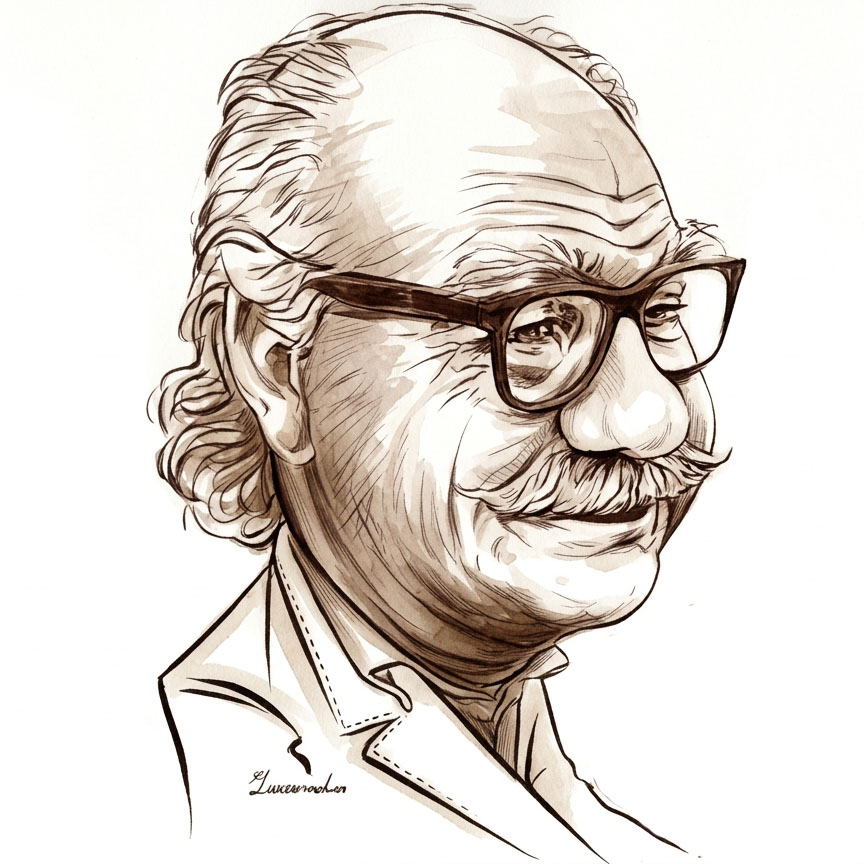
Historical Figure
Mumtaz Al Bahra
Modern
Lifespan
1938 – 2017
Period
53
Biography
Mumtaz Al-Bahra (May 9, 1938 – January 16, 2017) was a Syrian visual artist and cartoonist, born in Aleppo to a Damascene family, and regarded as one of the leading figures of the second generation of Syria's modern art movement and a prominent member of the Fine Arts Syndicate in Damascus. He studied art in Cairo before completing his degree at Damascus University's newly established Faculty of Fine Arts as part of its first graduating class, and worked as an art teacher for 23 years before dedicating himself fully to art. He became known as one of the founders of press and editorial cartooning in Syria starting in 1955, and was the first cartoonist in the country to be imprisoned for his drawings, while also contributing to numerous newspapers and magazines including Al-Thawra and Tishreen. He was also one of the most influential illustrators of Arab children's literature, co-founding the magazine "Usama" in 1969 with playwright Saadallah Wannous and writer Zakaria Tamer, creating characters beloved by generations of children. Among his most notable fine art works is the large panoramic painting "Maysaloun," displayed at the Tomb of the Unknown Soldier on Mount Qasioun. He died in Damascus at the age of 79 following a period of voluntary seclusion in a retirement home.
Mumtaz Al-Bahra
Syrian Visual Artist and Cartoonist
(May 9, 1938 – January 16, 2017)
Overview
Connection to Damascus
Belongs to a Damascene family; connected to Damascus through his family roots and artistic career in the Syrian art scene.
Mohammad Mumtaz Al-Bahra was born in Aleppo to a family of Damascene origin, a circumstance owed to his father’s work. His father, the athlete and educator Mahmoud Al-Bahra, was serving at the time as inspector of physical education in the city.
Al-Bahra is regarded as one of the leading figures of the second generation of Syria’s modern art movement. He held a prominent seat on the board of the Fine Arts Syndicate in Damascus and also worked as a teacher in several Syrian institutes and schools.
He took part in every official exhibition held across Syria’s various provinces. Internationally, he participated in the exhibition “Aspects of Syrian-Arab Art” at the World Festival in Cuba in 1978, and held a solo exhibition in Yerevan, Armenia. Among his most celebrated works is the massive panoramic painting “Maysaloun,” displayed at the Tomb of the Unknown Soldier museum on the slopes of Mount Qasioun.
Family Life
Al-Bahra, the eldest of his siblings, grew up in a conservative, aristocratic Damascene household. The family spent most of its time in a working-class district of Damascus before later moving to the Muhajireen neighborhood, considered relatively modern at the time.
He was twenty-five when his father died at the age of fifty-one, after which he took on responsibility for raising his younger brothers. The death of his middle brother, Mukhlis, at just 24 years old, left a deep and lasting wound. He married Ferdous Al-Bahra, and the couple had three children.
Education
Al-Bahra began studying art in Cairo during the period of union between Syria and Egypt, alongside Syrian classmates such as Nazir Nabaa and Ghazi Al-Khaldi, and Egyptian peers including Mohammed Al-Labbad. However, his father’s death in his fourth year of study, combined with the dissolution of the Syrian-Egyptian union, prevented him from completing his degree there, even though he was close to graduating.
He returned to Syria and was forced to restart from his second year at the newly established Faculty of Fine Arts at Damascus University, where he graduated with the college’s very first cohort, specializing in fine art painting and earning a Bachelor’s degree in Fine Arts. He stood out among his classmates and studied under prominent instructors including Mahmoud Hammad, Hussein Ismail, Mahmoud Jalal, and Said Tahsin.
Professional Career
Teaching
After graduating, Al-Bahra worked as an art teacher for 23 years. He began in the city of Al-Hasakah in northern Syria, teaching for two years at a teacher-training institute, before returning to Damascus to teach at several secondary schools and at a teacher-training institute. Finding it difficult to reconcile teaching with his artistic career, he resigned early.
Press and Editorial Cartooning
He launched his artistic career in 1955 through journalistic and satirical drawing, and is considered one of the founders of press cartooning in Syria, striving to introduce fine-art sensibilities into the genre. He was also among the earliest pioneers of educational illustration for schools in Syria, producing numerous illustrations for early education materials.
He was the first cartoonist in Syria to be arrested over his drawings. An arbitrary military field court, without trial, sentenced him to death alongside several other political detainees, including journalist Nasruddin Al-Bahra and Abbas Al-Sous. The sentence was revoked mere hours before its execution, following the Ba’athist faction’s defeat of the Nasserists in the March 8 coup.
Throughout his career, he contributed to numerous newspapers and magazines, including:
Al-Sarkha Al-Souriya (published by Ahmad Aloush)
Al-Ra’i Al-Aam
Sada Al-Sham
Al-Tala’i
Al-Thawra, and later Tishreen
Majallat Al-Mou’allimeen (Teachers’ Magazine), Majallat Al-Jundi (Soldier’s Magazine), and the Syrian Arab Television Magazine
He gave up cartooning in the early 1980s after facing harassment and threats from unknown parties targeting him and his family, as well as pressure from editors to soften the sharpness of his cartoons. However, the outbreak of the intifada in the occupied territories drew him back into the field; he mounted a cartoon exhibition in Damascus addressing the intifada and the suffering of the Palestinian people, later touring the exhibition through several Arab and foreign cities.
Children’s Literature
Al-Bahra is regarded as one of the most important illustrators of Arab children’s literature. He illustrated textbooks for Syria’s Ministry of Education that accompanied generations of children through their early school years, who came to love characters he created such as “Ward” and “Rabab.” Perhaps his most lasting impact on children across Syria and the Arab world came through his masterful illustration of comic-strip serials.
Usama Magazine
He is considered the spiritual father of “Usama” magazine, which he co-founded in 1969 with playwright Saadallah Wannous and short-story writer Zakaria Tamer, as well as the founder of “Al-Tifl Al-Arabi” (The Arab Child) magazine—both published by the Ministry of Culture in Damascus.
He delighted children with characters such as Usama, Shantir, Majid, and Sindbad, drawn from the stories of One Thousand and One Nights, working alongside distinguished writers such as Zakaria Tamer, Michel Kilo, Osama Daaboul, Khairy Al-Dhahabi, Adel Abu Shanab, and Rashad Abu Shawer, among others. He eventually left Usama magazine after Dalal Hatem took over its management.
Later Work
He subsequently worked for the Beirut-based Lebanese children’s magazine “Samer,” producing several illustrated serials for modest texts written by Adel Abu Shanab. He also worked with some local publications, including Al-Tala’i magazine, affiliated with the Baath Vanguards Organization.
Fine Art Works
Al-Bahra painted a number of oil paintings, though his output in this medium was relatively limited overall. Among his most important works is “Maysaloun,” displayed in the Unknown Soldier panorama on the slopes of Mount Qasioun, spanning an area of 25 square meters.
Death
Mohammad Mumtaz Al-Bahra died in Damascus on the morning of Monday, January 16, 2017, at the age of 79, of natural causes, following a period of voluntary seclusion at the “Dar Al-Sa’ada” retirement home.