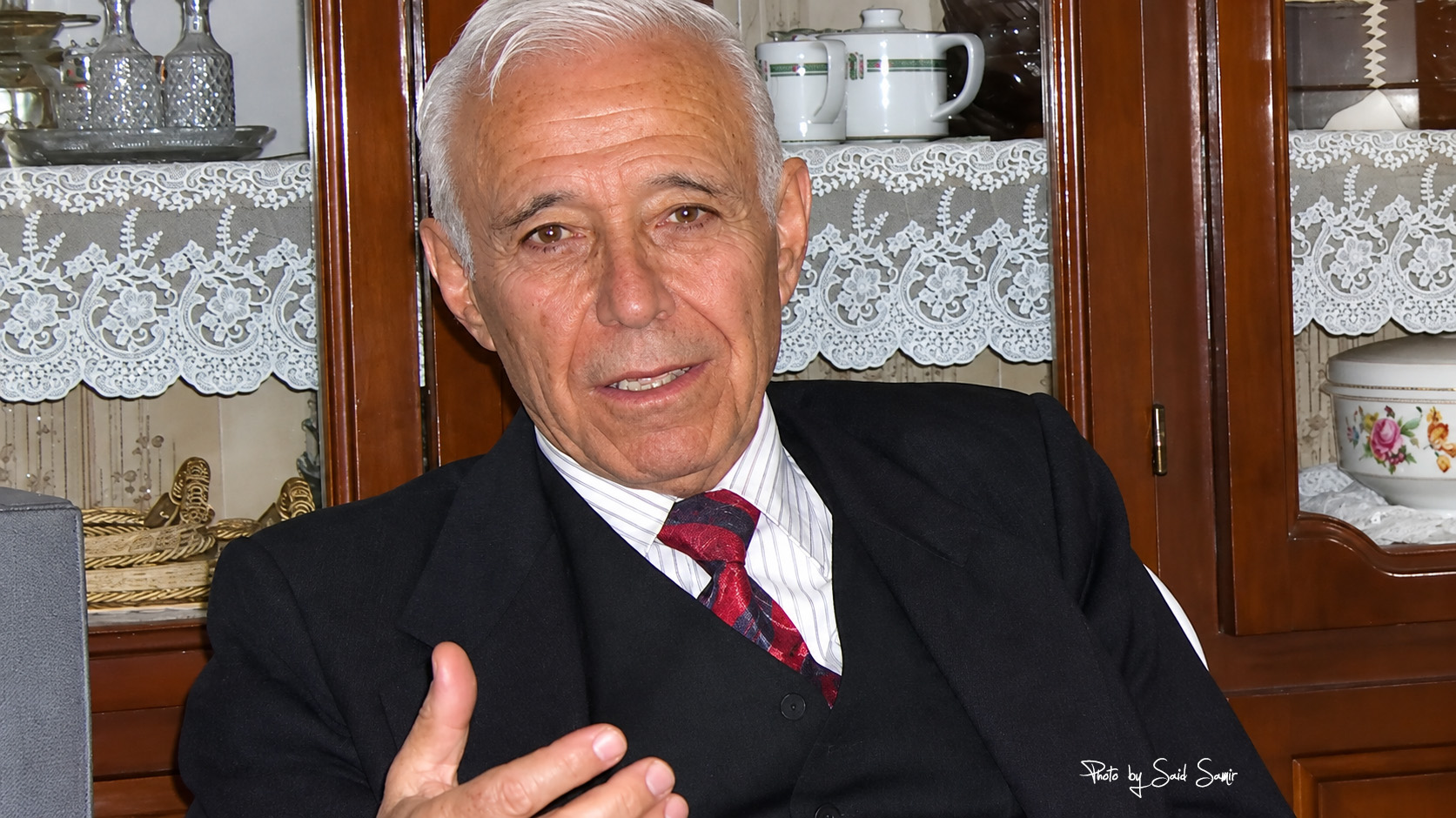
Historical Figure
Tayyeb Tizini
Tayeb Tizini: From Homs to a Project of Arab Renaissance
Who Is He?
Tayeb Tizini was a Syrian thinker and philosopher. His journey began in Homs, and he later became one of the most prominent names in contemporary Arab thought. He is known for his bold project of re-reading Arab thought and for his lifelong attempt to connect philosophy, history, politics, and renaissance.
Beginnings: From Homs to Europe
-
He received his early education in Homs.
-
After finishing his initial studies, he left for Turkey, then Britain, and then Germany.
-
In Germany, he completed his studies in philosophy:
-
A doctorate in philosophy in 1967.
-
A doctorate in the philosophical sciences in 1973.
-
-
He taught at the University of Damascus and worked as a professor of philosophy until his death.
Politics: An Early Experience, Then a Return to Thought
Before leaving Syria, he took part in some leftist parties that had emerged in Syria. But he says he always returned to intellectual work, especially political thought. His party experience was not merely a passing phase; it later pushed him to theorize Arab political thought and to read the Arab political heritage in depth.
The Great Project: A New Vision for Arab Thought
His doctoral dissertation was titled:
“Introduction to Medieval Arab Philosophy”, and it was published in German in 1972.
Then his first book in Arabic appeared:
“A Project for a New Vision of Arab Thought in the Medieval Era” in 1971. It was printed five times.
This book was the nucleus of a huge project consisting of 12 parts, of which he completed six. Among the most important are:
-
“Arab Thought in Its Early Beginnings and First Horizons” 1982.
-
“From Yahweh to Allah” 1985.
-
“Preliminary Introductions to Early Muhammadan Islam” 1994.
The Great Shift: From Revolution to Renaissance
From the mid-1990s onward, influenced by the collapse of the Soviet Union and the decline of the revolutionary national project, a radical shift took place in his thinking.
The summary:
-
Instead of the concept of revolution, he moved to the concept of renaissance (nahda).
-
Instead of a class-based carrier, the carrier became the whole society or the whole nation.
-
Instead of excluding religion, he now saw the need to understand religious experience from within, because the majority of people draw nourishment from religious thought.
His book that summarized this shift was titled:
“From Heritage to Renaissance”, after it had previously been “From Heritage to Revolution.”
How Does He Think? His Method in the Simplest Form
Tizini’s method rests on:
-
Plurality: No one possesses absolute truth.
-
Scientific and democratic dialogue: The need to acknowledge error and correctness.
-
The materialist, dialectical, historical method: Reading thought within its economic, social, and political conditions.
-
The dialectic of logic and history: An idea cannot be understood apart from its history.
-
Rejection of Eurocentrism: Arab thought is not merely an extension of Greek thought, but an original part of human thought.
His Major Positions
1. Against Eurocentrism
He argues that Arab and Islamic thought in the medieval era is an essential part of the history of human thought. Therefore, he rejects the view that treats human intellectual history as only European history: beginning with Greece, then the Renaissance, then modernity.
2. Islam as a Social Movement
He does not view Islam only as a religious creed, but as a social movement with its own economic, social, and political conditions. He therefore studies the time before and after Islam and analyzes tribal relations, slaves, ordinary people, usurious capital, and the emergence of an Islamic movement that offered a way out of the crisis of pre-Islamic society.
3. Secularism
He raises the slogan:
“Religion is for God, and the homeland is for all.”
He distinguishes between:
-
The creedal function: the believer’s relationship with God, which is personal and protected.
-
The civilizational function: legislation and social and economic relations, which are open to development.
4. The Qur’an: A Text with Many Faces
He sees the Qur’an as a flexible text with multiple readings, and he cites the saying:
“The Qur’an has many faces; take its beautiful face.”
He stresses that understanding the text is connected to reality, the occasions of revelation, knowledge, ideology, and history.
5. His Critique of al-Jabiri
He devoted an entire book to criticizing al-Jabiri’s reading of Arab thought:
“From Western Orientalism to Maghrebi Occidentalism.”
He argues that al-Jabiri fell into:
-
Unhistorical structuralism.
-
The duality of the Arab mind/Arab mentality.
-
A hidden Eurocentrism.
-
Separating thought from its social context.
The Project of Renaissance and Enlightenment
In his book “A Manifesto on Arab Renaissance and Enlightenment,” he lays out the conditions for renaissance and the obstacles facing it.
Obstacles to Renaissance:
-
Fundamentalism and political Islam.
-
Catch-up developmentalism.
-
Functional structuralism.
-
Deconstructive structuralism and postmodernism.
-
The end of history and the decline of ideology.
-
Globalization and post-Zionism.
The Carrier of Renaissance:
From the far national and national-democratic right to the far national and national-democratic left.
Renaissance Without Enlightenment?
It is incomplete. For renaissance needs:
-
Rationality.
-
Historicity.
-
Self-criticism.
-
Plurality.
-
Peaceful transfer of power.
-
Real intellectuals, not intellectuals of the security apparatus.
Among His Most Important Works
-
A Project for a New Vision of Arab Thought in the Medieval Era.
-
On the Problems of Revolution and Culture in the Third World.
-
From Heritage to Revolution.
-
Arab Thought in Its Early Beginnings and First Horizons.
-
From Yahweh to Allah.
-
On the Path of Methodological Clarity.
-
Chapters in Arab Political Thought.
-
The Qur’anic Text Before the Problematic of Structure and Reading.
-
From Western Orientalism to Maghrebi Occidentalism.
-
From the Trinity of Corruption to the Issues of Civil Society.
-
A Manifesto on Arab Renaissance and Enlightenment.
-
Horizons of Contemporary Arab Philosophy.
Stations and Activities
-
He published hundreds of studies and research papers.
-
He participated in dozens of Arab and international conferences.
-
He supervised Syrian, Arab, and foreign graduate students.
-
In 2001, he was elected a member of the Committee for the Defense of Freedoms in the Arab World.
-
In 2004, he helped found the Syrian Organization for Human Rights, “Sawasiya.”
-
In 1998, he was chosen by the German-French philosophical foundation Concordia as one of one hundred philosophers of the twentieth century.
Why Does He Matter to Syrian Youth Today?
Because he is a model of a Syrian thinker who did not stop at criticism, but tried to build a project:
-
That does not reject all heritage.
-
That does not sanctify all heritage.
-
That does not import the entire West.
-
That does not close in on itself.
-
That calls for a comprehensive, rational, historical, democratic renaissance.
Quick Summary
-
From Homs to Germany.
-
From the left to political thought.
-
From revolution to renaissance.
-
From class to nation.
-
From excluding religion to understanding it from within.
-
From a one-dimensional reading to plurality.
-
From Eurocentrism to an open humanity.
Tayeb Tizini is not only a Syrian philosopher; he is an enduring call to the youth of Syria to read their heritage with a critical mind, to open themselves to the world with confidence, and to seek a renaissance that neither erases their identity nor closes off their future.